FMEA
A severity-10 failure mode stays at the top.
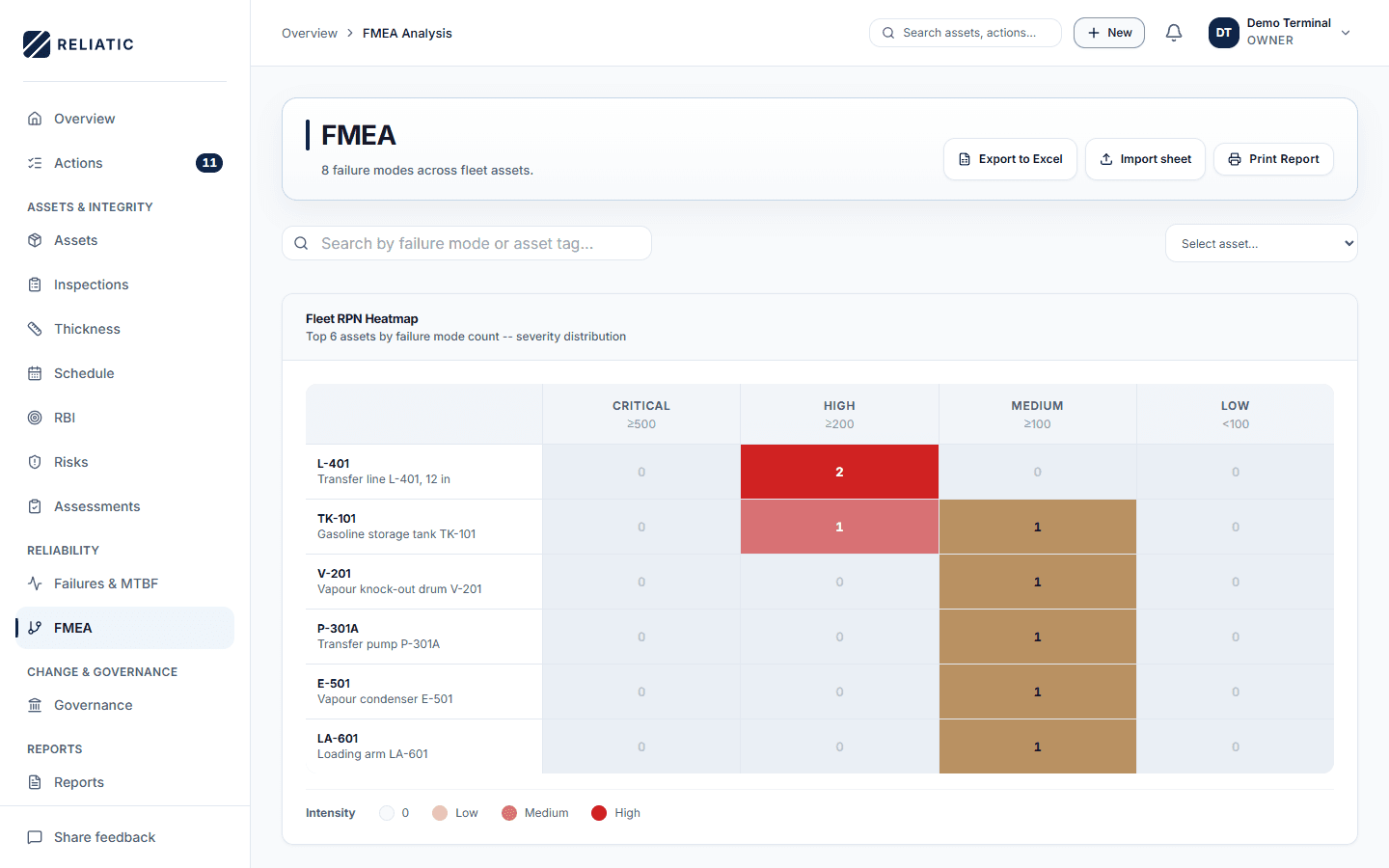
Failure modes with severity, occurrence and detection, a calculated RPN, and a priority that a high-severity mode cannot fall out of.
What it does today
- Failure modes per asset with cause, effect and current controls
- Severity, occurrence and detection as whole numbers from 1 to 10
- RPN = S × O × D, calculated by Reliatic
- High priority when RPN is 200 or more, or when severity is 9 or 10. Medium when RPN is 100 or more
- A library of failure-mode templates to start from, and a spreadsheet import
The basis
- RPN = Severity × Occurrence × Detection
- High: RPN ≥ 200 or S ≥ 9 · Medium: RPN ≥ 100 · otherwise Low
Severity × occurrence × detection (RPN). This is not the AIAG-VDA Action Priority table
Where the spreadsheet goes wrong
In Excel: RPN = S × O × D ranks a severity-10, occurrence-1 mode below a 5 × 5 × 5 mode. Safety-critical modes sink to the bottom of a sorted sheet.
In Reliatic: Severity 9 or 10 is high priority, whatever the RPN.
Questions
How is the FMEA priority set?
RPN is severity × occurrence × detection, calculated by Reliatic. A mode is high priority when RPN is 200 or more, or when severity is 9 or 10, and medium when RPN is 100 or more.
Is this the AIAG-VDA Action Priority table?
No. Reliatic uses the RPN (severity × occurrence × detection) with a severity override, not the AIAG-VDA Action Priority table.
Try it on your own data
14-day trial, no card. We set it up within one business day. Priced per organization. Ask for a quote. Paid by invoice.